
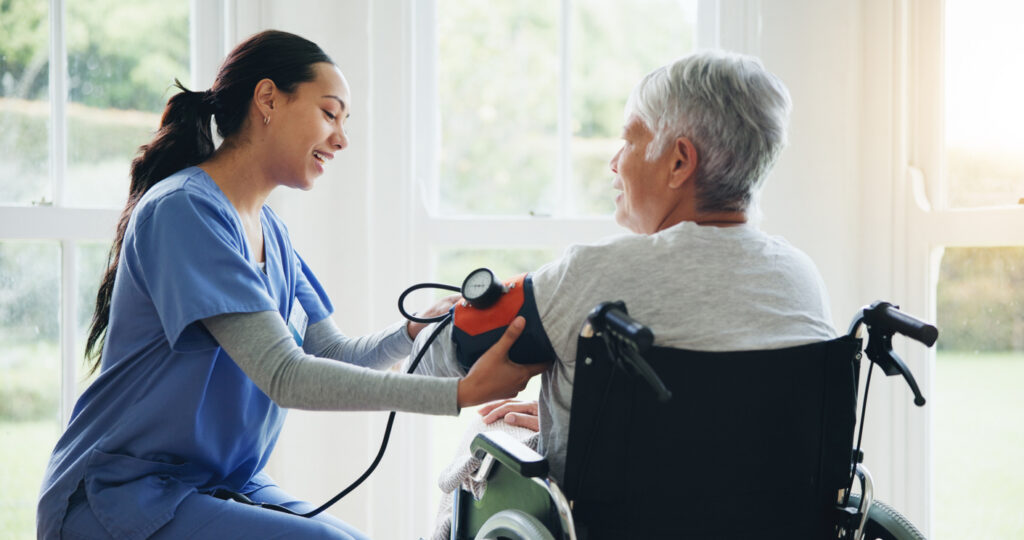
Quick Summary: Choosing between home health care and skilled nursing can feel confusing, especially when both may include nursing, therapy, and senior rehabilitation services. This guide from Windsor House breaks down the difference between skilled nursing and home health care, how much support is available, and what families should consider for a loved one after a hospital stay, illness, or injury.
When a loved one is about to be discharged from the hospital, the first thing on their family’s mind is: How soon can they come home? However, there is typically another more difficult question that follows: How can I make sure they have the support they need when they get there?
Depending on what type of procedure or illness they are recovering from and their individual mobility and rehabilitation needs, home health care or skilled nursing can help ensure they receive the level of support they need to heal and recover as quickly as possible. Understanding the difference between these options can make an important decision easier to navigate.
At Windsor House Communities, we talk with many families every day about these choices. We know the choice may seem confusing at first. In this guide, we break down home health care vs. skilled nursing, explain what types of support each service provides, and answer common questions families often ask to help you decide what’s best for your loved one.
What Is Home Health Care?
Home health care allows your loved one to recover in their own home, with regular visits from a nurse or therapist. It’s often used after a hospital stay, surgery, illness, or injury when someone is well enough to be home but still needs help with recovery.
Depending on what’s needed, that can include:
- Nursing and wound care
- Medication support and education
- Physical therapy, occupational therapy, or speech therapy
- Monitoring of ongoing health conditions
- Social work services
- Patient education and medication administration
- Post-operative patient instruction for medical devices
- Caregiver education
- Nutritional assessment and guidance
- Limited home health aide support, when needed
Home health care is a good fit for older adults who are medically stable, can manage safely between visits, and only need professional support at certain times.
For families who choose this path, Windsor House also offers Windsor Home Health. The staff at Windsor Home Health works in partnership with each patient’s family to meet their needs from the comfort of their own home. We offer a wide variety of home health care services, including the types of services listed above. Additionally, we offer many specialized services, including cardio/pulmonary assessments, pressure ulcer treatment and caregiver education, diabetic teaching, and nutritional assessments.
Windsor Home Health is one of the few home health agencies in Northeast Ohio to be accredited by the Accreditation Commission for Health Care (ACHC). This accreditation demonstrates our commitment to maintaining quality care.
For more information about Windsor Home Health, reach out to our team.
What Is Skilled Nursing?
Skilled nursing is designed for older adults who need more hands-on medical care and support than they can safely manage on their own at home. This type of care is often recommended after a hospital stay, surgery, illness, or injury when the trajectory of a person’s recovery requires more time for them to regain their strength, improve mobility, and manage medication dosing. Depending on the individual’s situation and their progress prior to being discharged, a doctor may recommend that they receive ongoing nursing and therapy support.
In a skilled nursing community, care is available 24/7 and typically includes:
- Nursing care and ongoing monitoring
- Medication management
- Wound care
- Physical, occupational, and speech therapy
- Mobility support for walking and transfers
- Assistance with activities of daily living such as bathing, feeding, and dressing
- Nutritional support
At our skilled nursing communities across Northeast Ohio, we provide personalized services and specialized support based on each individual’s needs, abilities, and recovery goals, working closely with families, physicians, and therapists. We also coordinate services such as lab work, X-rays, and pharmacy support, so families don’t have to juggle multiple providers during an already stressful time.
Home Health Care vs. Skilled Nursing: What’s the Difference?
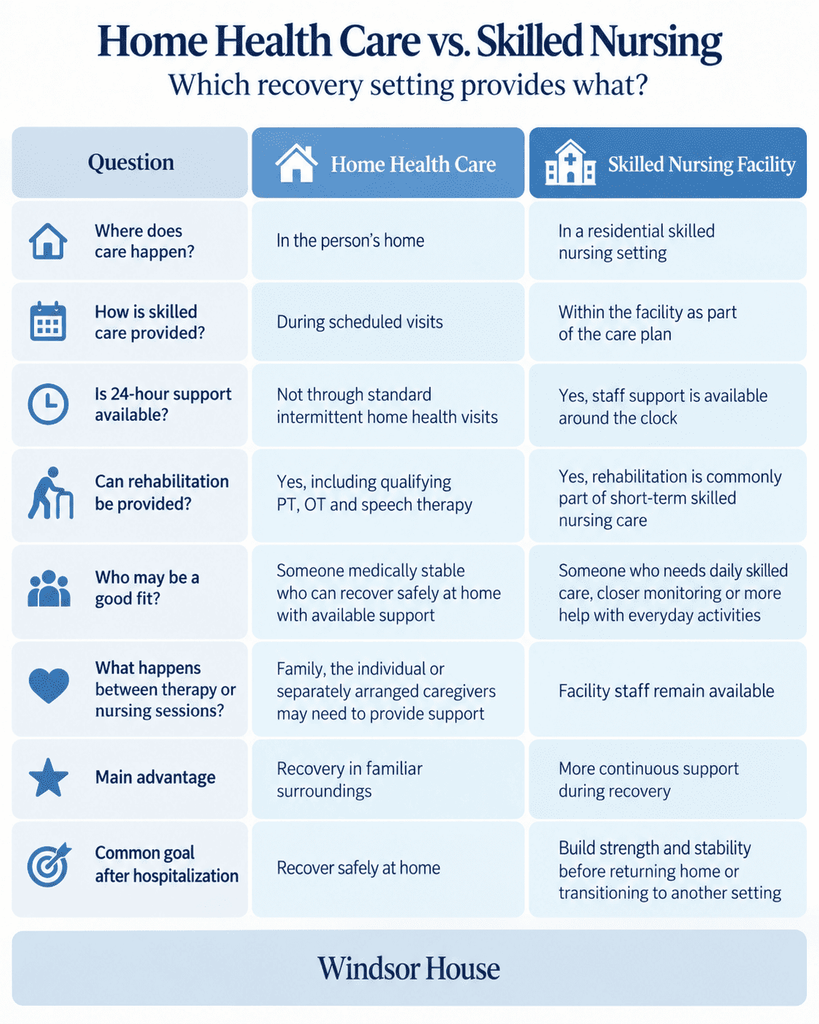
The main differences between skilled nursing and home health care come down to where care is provided, how much support is available throughout the day, and the level of help a person may need during recovery.
For a quick and easy comparison, refer to the infographic below.
Two Situations, Two Different Fits
Consider someone recovering from a knee replacement. They may be able to get out of bed, use a walker, get to the bathroom, and manage their own medications, and their spouse may be around if they need a hand. In situations like these, home health care may be a better option: a physician orders nursing or therapy visits, with family or other caregivers providing any additional help needed between visits.
Now consider someone leaving the hospital after a serious illness. They may still feel weak, require help to stand safely, and have treatment needs that require closer attention and monitoring. If something happens in the middle of the night, people in this situation would need someone available to respond quickly. In a situation like this, skilled nursing care may be a more appropriate option to ensure they have enough support to safely rebuild strength and fully recover before returning home.
A stay in a skilled nursing community doesn’t necessarily mean a permanent move. For many people, short-term rehabilitation is one step in recovery, providing time and support to regain enough strength, mobility, and confidence to return home safely.
8 Questions to Ask Before Hospital Discharge
Discharge conversations often happen quickly, giving families a limited amount of time to plan for support resources. Asking these questions can help you gather the details you need to make a more informed, confident decision:
The Post-Hospital Care Checklist
1. What Level of Care Will Be Needed and How Often?
Ask if your loved one is capable of recovering at home or if skilled nursing care will be needed. Refer to the doctor’s discharge instructions to determine how often support is needed. Will your loved one require around-the-clock care or will a few scheduled visits a week be sufficient?
2. Is My Loved One Able to Transfer In and Out of Bed?
If not, check the discharge instructions on how much movement they are allowed to do and what level of assistance is required. If you and your family are not able to provide this level of support, skilled nursing care may be a better option. For some injuries, surgeries, etc., the doctor or hospital staff may need to demonstrate how to get your loved one in and out of the car safely. .
3. Will They Need Assistance With Mobility?
Find out whether they can walk independently, or if they should use a walker or other mobility support. Do they need hands-on assistance?
4. Can We Manage Their Recovery With Home Health Care?
Be sure to ask about wound care, medication schedules, injections, monitoring, and any ongoing needs that may require professional attention.
5. Do They Need 24/7 Monitoring and Support?
Be honest with yourself and your fellow caregivers about how much support family members can realistically provide, especially overnight and during the workday. If there will be gaps in coverage, skilled nursing may be a better option.
6. Is Their Home Ready for Recovery?
Determine if you need to obtain any medical equipment or supplies before they return home. Evaluate potential fall hazards, such as stairs, bathrooms, and narrow hallways. Will any home modifications need to be made?
7. How Much Rehabilitation Do They Need, and How Often?
Ask the physical, occupational, or speech therapy team what frequency and level of support your loved one needs to fully recover.
8. What Do We Need To Have Ready for Them When They Come Home?
Instead of just asking “When can they go home?” ask the care team about any additional support, devices, medication management, wound care, etc. they will need on a daily basis. What are the most critical items that need to be in place?
Even if there are several areas to address, it does not necessarily mean home health care is not an option. However, having an honest conversation up front while the hospital staff is still available to answer your questions will help you and your family get a more complete picture of what the recovery process looks like and the amount of care required.
These decisions can be difficult and weigh heavily on you and your family. To help keep the conversation focused on care and logistics, make sure these three areas are covered:
- Medical complexity: Does their recovery require complex monitoring or procedures such as managing feeding tubes and IVs? Are we comfortable managing this on our own and confident we will be able to do this?
- Support coverage: When does someone need to be there? Based on schedules, childcare needs, etc., are we able to ensure someone is there 24/7 if needed?
- Mobility and safety: Is there a high risk of falling? What needs to be done to ensure their home is safe? Is their bedroom downstairs or do we need to prepare a room on the ground floor?
How Windsor House Can Help Support Recovery
Choosing skilled nursing after a hospital stay doesn’t necessarily mean giving up on the goal of returning home. In many cases, it can provide the additional time and support your loved one needs to fully recover before the transition takes place.
At Windsor House, we have been caring for families since 1959. Our Skilled Nursing communities go beyond meeting medical needs to provide a welcoming environment for recovery. Our Windsor Home Health team offers professional care and therapy for eligible individuals who are able to recover safely at home.
If you are trying to understand whether skilled nursing or home health care may be the right next step for someone you love, you can always talk with the Windsor House team to learn more about the care and support available.
You can also explore our 16 locations across Northeast Ohio to find a Windsor House location close to home and learn more about the services offered there.
Frequently Asked Questions
Not exactly. Skilled nursing is a broader category of professional health care that may include nursing as well as skilled therapy. Senior rehabilitation commonly includes physical, occupational, or speech therapy designed to help someone regain or maintain abilities after illness, injury, or surgery. Rehabilitation may be provided in a skilled nursing community or, when appropriate, through home health care.
Yes. Someone may receive skilled nursing or senior rehabilitation after hospitalization and later transition home with home health care once they are medically stable and able to recover safely at home. The transition should be coordinated with their physician, rehabilitation team, discharge planner, and family.
Start by looking for a community that can support the level of nursing and rehabilitation your loved one needs while also making it easy for the family to stay involved. Consider the location, available therapies, 24-hour support, approach to care, dining, activities, and how comfortable the community feels overall.
If you are searching for a skilled nursing community near Northeast Ohio or Western Pennsylvania, Windsor House has multiple skilled nursing communities across the region. You can explore our locations to find the community closest to home, or talk with our team if you would like help understanding which option may best fit your loved one’s needs.